A WordPress Marketing System Starts with the Right Foundation
By Edward A. Sanchez
Founder, Brass Ring Web Design | WordPress Specialist
I’ve been building business websites since 1998, specializing in WordPress since 2010, and I’ve seen this pattern repeatedly. Over the years, I’ve found that what actually drives growth isn’t just having a site — it’s building a structured WordPress marketing system around it. I’ve been building business websites since 1998 specializing in WordPress since 2010, and the pattern is consistent. The businesses that grow aren’t the ones with the flashiest homepage. They’re the ones that connect their website to a deliberate system of traffic, engagement, and follow-up.
Thanks for reading this post and Brass Ring also thanks those whose content is shared here on our website. We present it in order to pass on their knowledge to our small business clients so it can help them remain informed, healthy and growing their businesses. Please bookmark our site, subscribe to our newsletter and come back for more marketing, small business & WordPress tips, advice, tools & news! - Edward A. Sanchez
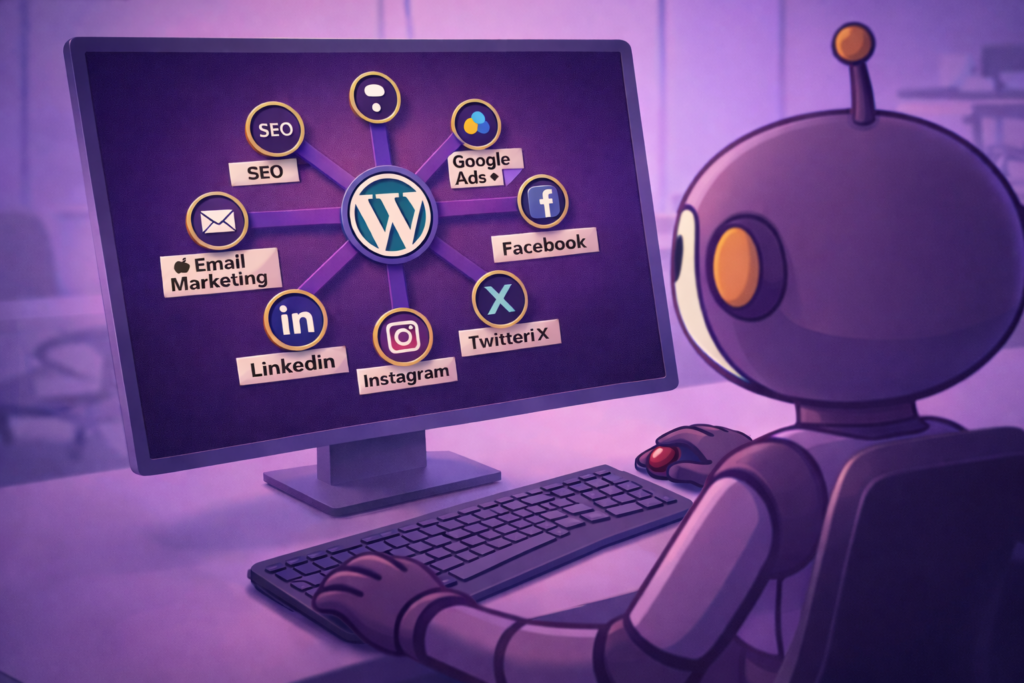
Think of your WordPress website as the hub of a wheel. Everything else — your outreach, advertising, content, and campaigns — functions as spokes feeding energy back to that hub. When those spokes are aligned, things move. When they’re not, the wheel wobbles.
Here are the seven spokes I believe every serious business website should have.
1. SEO (Search Engine Optimization)
If someone searches for what you do and you don’t show up, you’re invisible. SEO isn’t magic. It’s structure, clarity, and consistency. It’s clean page hierarchy, thoughtful internal linking, and content that actually answers the questions your prospects are asking.
One of the reasons I’ve stayed with WordPress for so long is that it supports this beautifully — when it’s configured properly. But it doesn’t happen automatically. It takes intention. Organic search is long-term leverage. You build it correctly, and it keeps working for you.
2. Email Marketing
Social media followers are borrowed. Email subscribers are owned. Your WordPress site should be collecting email addresses on purpose, not as an afterthought. A lead magnet, a newsletter signup, an event registration — these simple systems add up.
As a Constant Contact Partner, I’ve worked with businesses that finally put structure behind their email marketing instead of “just sending something once in a while.” When your website and your email platform are working together, you create momentum. You nurture interest. You guide people toward action. Email isn’t outdated — it’s foundational.
3. LinkedIn
If you’re in B2B, LinkedIn matters. It builds visibility and professional credibility. But it should point back to your website. Your full positioning, your services, your proof — that lives on your site.
I see many professionals treating LinkedIn as their primary home base. That’s fine for awareness. But conversion should happen on property you control. LinkedIn builds exposure. Your website builds trust.
4. Facebook
Facebook still works, especially for local businesses and community-driven organizations. Groups, events, and targeted ads can drive meaningful traffic. But it’s rented space. You don’t control the algorithm, and you don’t control the reach.
Use it strategically. Just don’t confuse activity with ownership. Your website is where decisions happen.
5. Instagram
Instagram builds familiarity. Behind-the-scenes content, short-form video, and brand storytelling help people feel like they know you. That connection matters, particularly for service-based businesses.
But when someone is ready to make a decision, they don’t stay on Instagram. They go looking for your website. Instagram builds connection. Your website builds confidence.
6. X (formerly Twitter)
X is useful for timely insights and short-form thought leadership. It keeps you visible and allows you to engage in real-time conversations. But depth doesn’t live there. Depth lives on your website — in articles, case studies, service pages, and resources that fully explain what you do.
Short form sparks interest. Long form earns commitment.
7. Google Ads (Used Strategically)
Paid traffic can be powerful — when the foundation is solid. If your messaging is unclear or your landing pages are weak, ads will simply amplify the problem. But if your WordPress hub is structured properly, Google Ads can accelerate growth in a measurable way.
Advertising shouldn’t compensate for a broken system. It should scale a working one.
The Bonus Spoke: Print (When Used Intentionally)
Print isn’t dead — it’s just often disconnected. A well-designed business card, a thoughtful leave-behind, or even targeted direct mail can still work. The key is integration.
Print should point back to your WordPress marketing system. A card should lead to a landing page. A flyer should support a measurable offer. When print feeds your digital hub, it strengthens the system. When it stands alone, it fades quickly.
That’s why I call it a bonus spoke. Not mandatory for every business, but powerful when used strategically.
The Bigger Picture
Most small businesses don’t struggle because they lack effort. They struggle because their marketing pieces aren’t connected. A few social posts here. An occasional email there. Maybe an ad campaign when things slow down.
What changes everything is when you treat your WordPress site as the center of a deliberate ecosystem. Traffic comes in. Value is delivered. Conversions are captured. Follow-up happens consistently.
If you only have a website, you have a presence. When you build the spokes around it, you have a system.



Leave a Reply
You must be logged in to post a comment.